
Michael Saylor Says Banks Are Bringing Bitcoin To Clients — But Who Really Owns The $2.35 Billion?



Michael Saylor has drawn attention to a remarkable shift in Wall Street’s relationship with Bitcoin, highlighting how Wells Fargo’s brokerage businesses more than doubled their holdings of BlackRock’s Bitcoin exchange-traded fund during the third quarter. But behind the impressive numbers lies an even more interesting question: who is actually accumulating Bitcoin exposure?
The comments arrive shortly after Bitcoinist reported that Wells Fargo and its associated investment businesses disclosed approximately $2.35 billion in BlackRock’s iShares Bitcoin Trust (IBIT) shares.
While the headline figure suggests substantial institutional participation, the underlying regulatory filing reveals a more nuanced development that could be particularly important for Bitcoin’s long-term adoption.
Rather than representing a single corporate investment, much of the reported exposure is associated with brokerage and wealth-management operations.
Michael Saylor Highlights A Major Shift In Bitcoin Ownership
Strategy Executive Chairman Michael Saylor recently took to X to highlight the growing role of traditional banks in connecting customers with Bitcoin.
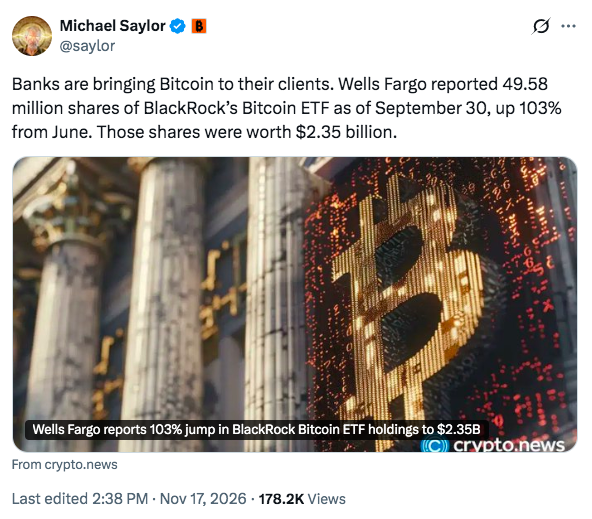
Saylor pointed out that two Wells Fargo brokerage businesses reported approximately 42 million shares of BlackRock’s Bitcoin ETF at the end of September, compared with roughly 20 million shares at the end of June.
The increase represents approximately 110% growth in reported shares over three months.
The figures are particularly interesting because the two brokerage businesses account for the majority of Wells Fargo’s overall IBIT position.
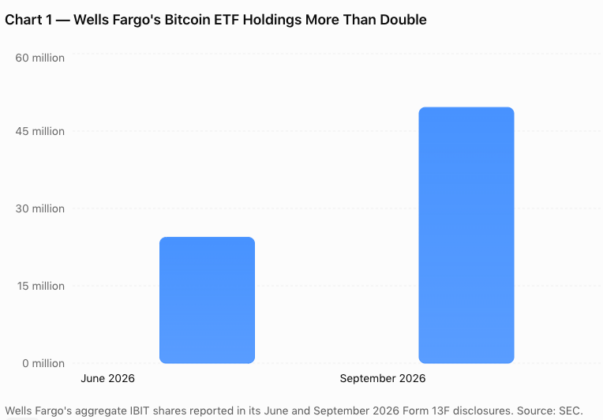
According to the company’s official SEC filing, Wells Fargo and its associated investment managers reported 49,577,094 IBIT shares as of September 30.
That compares with 24,396,222 shares at the end of June, representing an increase of approximately 103%.
However, these figures should not be interpreted as Wells Fargo purchasing $2.35 billion in Bitcoin for its own corporate treasury.
The filing includes positions associated with different investment-management entities, including securities managed or held for clients.
This distinction could be even more significant than the headline number itself.
Why Brokerage Clients Could Become Important For Bitcoin
For years, institutional Bitcoin adoption was closely associated with corporate treasury purchases and investment funds.
Companies such as Strategy helped establish Bitcoin as an asset that corporations could hold on their balance sheets.
However, the expansion of regulated Bitcoin ETFs has created another route for investors to access the cryptocurrency.
Instead of purchasing Bitcoin through specialized exchanges, investors can obtain exposure through conventional brokerage accounts, financial advisers, and wealth-management platforms.
Wells Fargo’s latest filing provides an example of how substantial this distribution channel has become.
Its two largest brokerage-related IBIT positions accounted for approximately 84.7% of the group’s reported shares.
This suggests that the growth of Bitcoin exposure through traditional financial services deserves closer attention.
Nevertheless, the filing does not identify every underlying investor or establish how much of the reported increase came from new retail customers rather than existing institutional accounts.
What it does demonstrate is that Bitcoin-linked securities are becoming an increasingly established part of conventional investment infrastructure.
The $2.35 Billion Figure Tells Only Part Of The Story
Another important consideration is the difference between the number of ETF shares held and their reported market value.
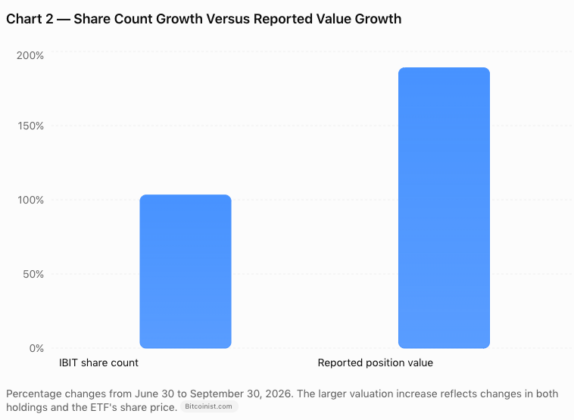
Wells Fargo’s aggregate IBIT share count increased approximately 103% between June and September.
However, the reported value of those shares increased from approximately $812 million to $2.35 billion, a gain of roughly 189%.
The difference reflects both the higher share count and changes in IBIT’s market valuation.
This distinction matters because a rising reported position value does not necessarily represent an equivalent amount of new capital entering Bitcoin.
Furthermore, the September 30 filing represents a historical snapshot.
It cannot establish whether Wells Fargo’s associated accounts maintained, reduced, or expanded their exposure during Bitcoin’s more recent market correction.
As Bitcoinist previously highlighted, BlackRock’s IBIT experienced a period of withdrawals before attracting renewed inflows on November 16.
The contrast between earlier quarterly accumulation and more recent ETF volatility demonstrates why institutional adoption should be evaluated over longer periods rather than through individual trading sessions.
Could Wall Street Distribution Become Bitcoin’s Next Major Growth Driver?
Saylor’s comments arrive as Bitcoin continues navigating a challenging market environment.
Although price volatility has affected investor sentiment, the expansion of traditional investment channels remains an important structural development.
Banks and brokerage platforms already maintain relationships with millions of customers, providing infrastructure that could make Bitcoin exposure more accessible to investors who prefer familiar financial products.
This does not mean every brokerage customer will purchase Bitcoin, nor does it guarantee that ETF demand will consistently increase.
Indeed, recent Bitcoin ETF withdrawals demonstrate that investors can reduce exposure just as quickly as they increase it.
However, the growing availability of regulated Bitcoin products represents a meaningful difference from earlier cryptocurrency market cycles.
Bitcoin no longer depends exclusively on specialized trading platforms to reach potential investors.
What Happens Next For Bitcoin Institutional Adoption?
We believe the most important takeaway from Saylor’s comments is not simply that Wells Fargo reported billions of dollars in Bitcoin ETF exposure.
It is that traditional brokerage infrastructure has become an important channel through which investors can participate in the Bitcoin market.
The next quarterly disclosures will help determine whether the growth reported in September continued during the subsequent period of market volatility.
For now, the latest figures reinforce a constructive long-term trend: Bitcoin is becoming increasingly accessible through established financial institutions.
And while short-term price movements remain uncertain, the expansion of traditional distribution channels could become one of the most important developments shaping Bitcoin adoption over the coming years.

Editorial Process for bitcoinist is centered on delivering thoroughly researched, accurate, and unbiased content. We uphold strict sourcing standards, and each page undergoes diligent review by our team of top technology experts and seasoned editors. This process ensures the integrity, relevance, and value of our content for our readers.


