
These Miners Cut Hashrate 50% as AI Revenue Doubles


IREN, Core Scientific (NASDAQ: CORZ) and TeraWulf (NASDAQ: WULF) together generated approximately $478 million in AI-cloud and HPC colocation revenue in the third quarter, double the $239 million recorded in Q2. Over the same period, their combined realized bitcoin hashrate fell approximately 49%, from 32.8 EH/s to 16.8 EH/s, according to TheEnergyMag calculations based on disclosed bitcoin production.
In a previous Q2 comparison, the central question was whether the economics of AI could justify the expense of converting mining facilities. Q3 provides more evidence that replacement revenue is arriving, although the timing and business models vary substantially.
IREN recorded the sharpest simultaneous change. Its realized hashrate fell from approximately 21.6 EH/s to 8.9 EH/s, while AI-cloud revenue increased from $70.5 million to $200 million. Installed mining capacity contracted from 23.2 EH/s to 7.9 EH/s, confirming that equipment removal accompanied the production decline.
Core Scientific’s estimated realized hashrate declined from 7.0 EH/s to 3.8 EH/s. Colocation revenue increased almost 58% to $215.4 million, accounting for approximately 92% of total quarterly revenue. The company ended September billing customers for 485 MW, up from 395 MW three months earlier. It expects to completely exit the mining business by the year’s end.
TeraWulf illustrates the lag between removing miners and collecting replacement revenue. Its realized hashrate was relatively stable in Q3 following earlier reductions, edging down from approximately 4.2 EH/s to 4.1 EH/s. HPC revenue nevertheless nearly doubled to $63 million, representing approximately 83% of total revenue.
Bitdeer (NASDAQ: BTDR) takes a much bigger slice
The rewards those miners are leaving behind remain available to competitors. Bitdeer is taking a growing share.
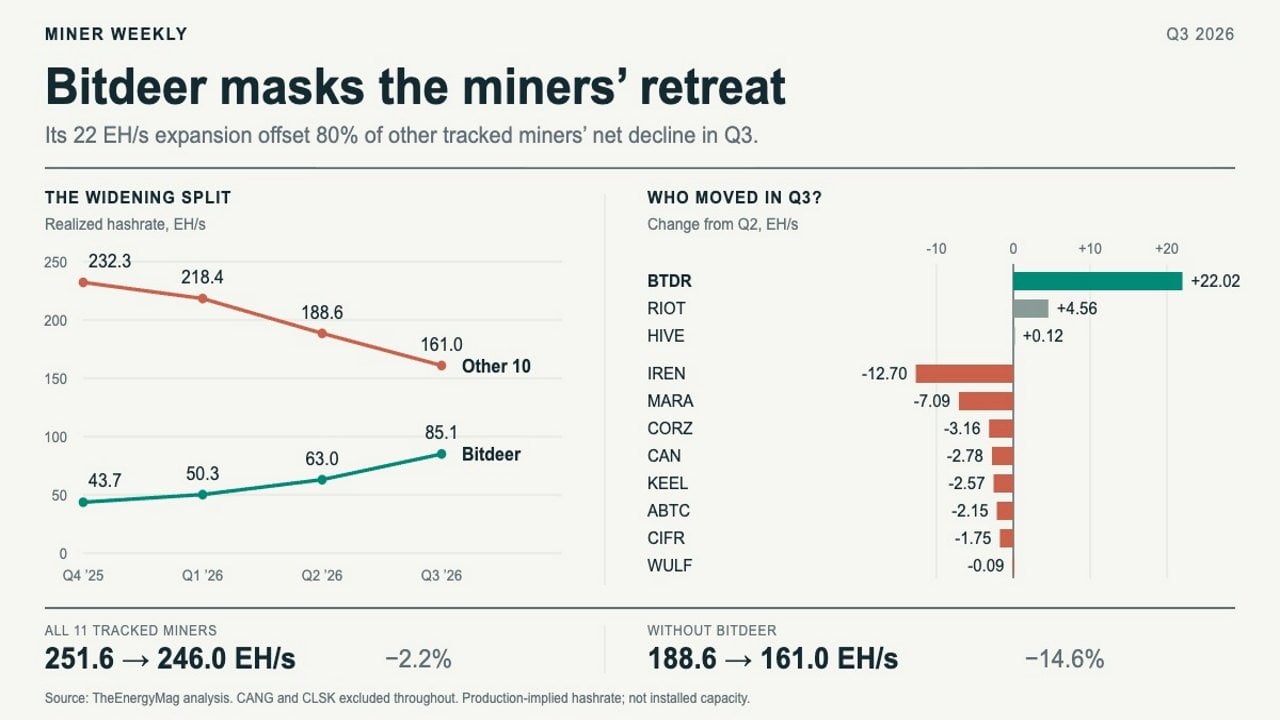
Its bitcoin production increased from 2,694 BTC in Q2 to 3,855 BTC in Q3, equivalent to approximately 9.2% of the quarter’s total network mining rewards. Its realized hashrate rose from approximately 63 EH/s to 85 EH/s, offsetting much of the contraction among its listed peers.
The quarterly average also understates where Bitdeer finished September. It produced 1,355 BTC that month, accounting for more than 9.7% of network rewards —approaching one bitcoin in every ten distributed to miners.
October production has yet to be reported. A further increase in its reward share could take Bitdeer above 10%, making the next operating update a useful test of how quickly it is gaining ground.
That expansion changes the picture across the wider public-miner group. A list of 11 companies that have disclosed their third-quarter earnings reports had approximately 246 EH/s of realized hashrate in Q3, down only about 2% sequentially. Excluding Bitdeer, the remaining companies contracted almost 15%, from approximately 189 EH/s to 161 EH/s.
The aggregate therefore conceals a widening divide: several large operators are withdrawing mining capacity, while one expanding competitor offsets much of their retreat.
Bitdeer is also building an AI business. Its AI-cloud revenue increased to $20.4 million from $14 million in Q2.
The hardware left behind
The AI conversion is also leaving a hardware overhang.
IREN and Keel together carried approximately $80.5 million of bitcoin mining equipment held for sale at the end of September, after write-downs. Core Scientific reported another $29.7 million of sale inventory combining mining, electrical and HPC equipment. These are accounting values of remaining inventory, rather than original purchase costs or completed sale proceeds.
Some machines are already changing hands. Cipher sold 6,840 Avalon A15Pro rigs back to Canaan (NASDAQ: CAN) earlier this year as Black Pearl shifted toward AI. The machines had originally been purchased in July 2025, showing that conversions can displace relatively new equipment alongside older fleets.
Other hardware faces a different destination. Ionic’s earlier prospectus earmarked approximately 73,400 machines for sale or scrap and another 19,100 for spare parts. TeraWulf reported 5,010 miners sold or otherwise disposed of during Q3, without separating resale from other disposals.
Q3 strengthens the evidence that AI can replace a meaningful share of miners’ operating revenue. Whether those conversions create attractive returns will depend on the capital required, financing costs, cash collections and the durability of customer demand.
Meanwhile, the miners still expanding are competing for the same finite stream of bitcoin rewards. Bitdeer’s approach toward a tenth of that stream makes it one of the clearest beneficiaries of its peers’ changing priorities.


